
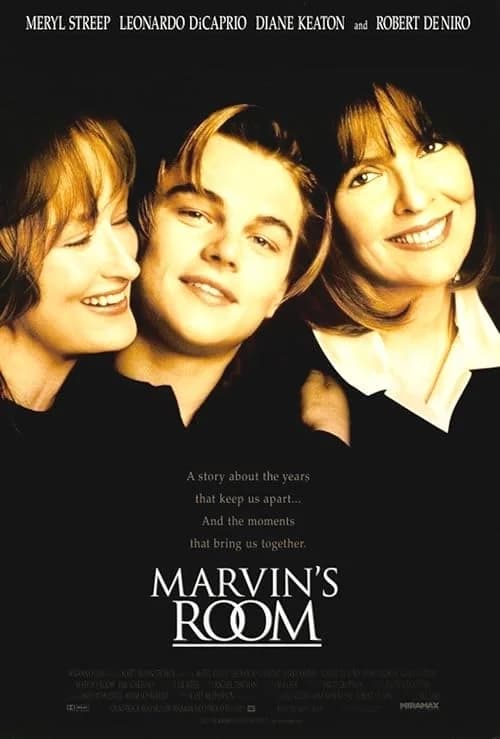
About Marvin's Room
Marvin's Room is a poignant 1996 family drama that explores the complexities of love, sacrifice, and reconciliation with remarkable emotional depth. Directed by Jerry Zaks and based on Scott McPherson's play, the film centers on Bessie (Diane Keaton), who has spent years caring for her ailing father Marvin and Aunt Ruth. When Bessie is diagnosed with leukemia, her estranged sister Lee (Meryl Streep) returns home after seventeen years with her rebellious son Hank (Leonardo DiCaprio), forcing the family to confront long-buried resentments and unspoken truths.
The performances are the film's greatest strength. Diane Keaton delivers a beautifully restrained and heartfelt performance as the selfless Bessie, earning an Academy Award nomination. Meryl Streep brilliantly captures Lee's defensive independence and gradual vulnerability, while a young Leonardo DiCaprio shows early promise as the troubled Hank, portraying adolescent anger and tenderness with equal conviction. Their chemistry creates authentic family dynamics that resonate deeply.
What makes Marvin's Room worth watching is its honest, unsentimental approach to difficult themes—chronic illness, family duty, and the possibility of redemption. The film avoids melodrama, instead finding power in quiet moments and genuine human connection. Its exploration of how families fracture and heal remains relevant, offering a moving portrait of the burdens and blessings of caregiving. For viewers seeking a thoughtful, character-driven drama with superb acting, Marvin's Room provides a compelling and emotionally satisfying experience that lingers long after the credits roll.
The performances are the film's greatest strength. Diane Keaton delivers a beautifully restrained and heartfelt performance as the selfless Bessie, earning an Academy Award nomination. Meryl Streep brilliantly captures Lee's defensive independence and gradual vulnerability, while a young Leonardo DiCaprio shows early promise as the troubled Hank, portraying adolescent anger and tenderness with equal conviction. Their chemistry creates authentic family dynamics that resonate deeply.
What makes Marvin's Room worth watching is its honest, unsentimental approach to difficult themes—chronic illness, family duty, and the possibility of redemption. The film avoids melodrama, instead finding power in quiet moments and genuine human connection. Its exploration of how families fracture and heal remains relevant, offering a moving portrait of the burdens and blessings of caregiving. For viewers seeking a thoughtful, character-driven drama with superb acting, Marvin's Room provides a compelling and emotionally satisfying experience that lingers long after the credits roll.